Guides
- matterport alternative
- matterport alternatives
- matterport pricing
- matterport api
- matterport competitors
- white label virtual tour
Matterport Alternatives for Software Platforms: What to Compare Before Choosing
How a software platform should compare Matterport alternatives, from 360° camera services and phone apps to capture SDKs, pricing models and the API.

Most of the people who come to us looking for a Matterport alternative have never owned a 360° camera. They build software for appraisers, inspectors, adjusters or property managers. Their users already walk through thousands of homes a year for their own jobs, and the platform wants a tour or a floor plan out of each of those visits.
The lists you find online compare cameras and image sharpness, because they were written for photographers who shoot one listing at a time. A platform buys for different reasons. In my experience the decision comes down to who holds the phone, which app they hold it in, whose name the end client sees, and how the bill behaves when your volume doubles in spring. Image quality almost never ends up deciding anything.
Why a platform looks for a Matterport alternative
When a photographer picks a tool, the capture is the job. For your users it is a side task squeezed into a visit that exists for some other reason. An inspector is there to inspect. An adjuster is there to price a claim. Anything that adds a second device or a second app to that visit gets resisted, and soon stops being used.
What Matterport sells today
To be fair to Matterport, start with what its own pages say. Its subscription plans support Matterport's cameras (Pro3 and Pro2), a list of supported 360° cameras, and supported iOS and Android phones. The Pro3 is described as a LiDAR camera for indoor and outdoor capture.
You buy a Platform Subscription Plan, monthly or annual. Each plan has an Active Space Limit, which is the number of spaces you can host at the same time, and a set number of users. There is also a Pro3 package that bundles the camera with a 24-month plan. Schematic floor plans, E57, CAD and BIM files and some other outputs are add-ons sold separately, and some of them need a Matterport camera.
For developers there is the Showcase SDK, which controls Matterport's 3D player, and the Matterport APIs (GraphQL) for looking up and managing model data, assets and accounts. On the plans page the standard API/SDK is sold separately on Professional plans and included on Enterprise. I am deliberately leaving prices out. They change often enough that anything I wrote here would be stale by the time you read it, so check Matterport's site for the current plans.
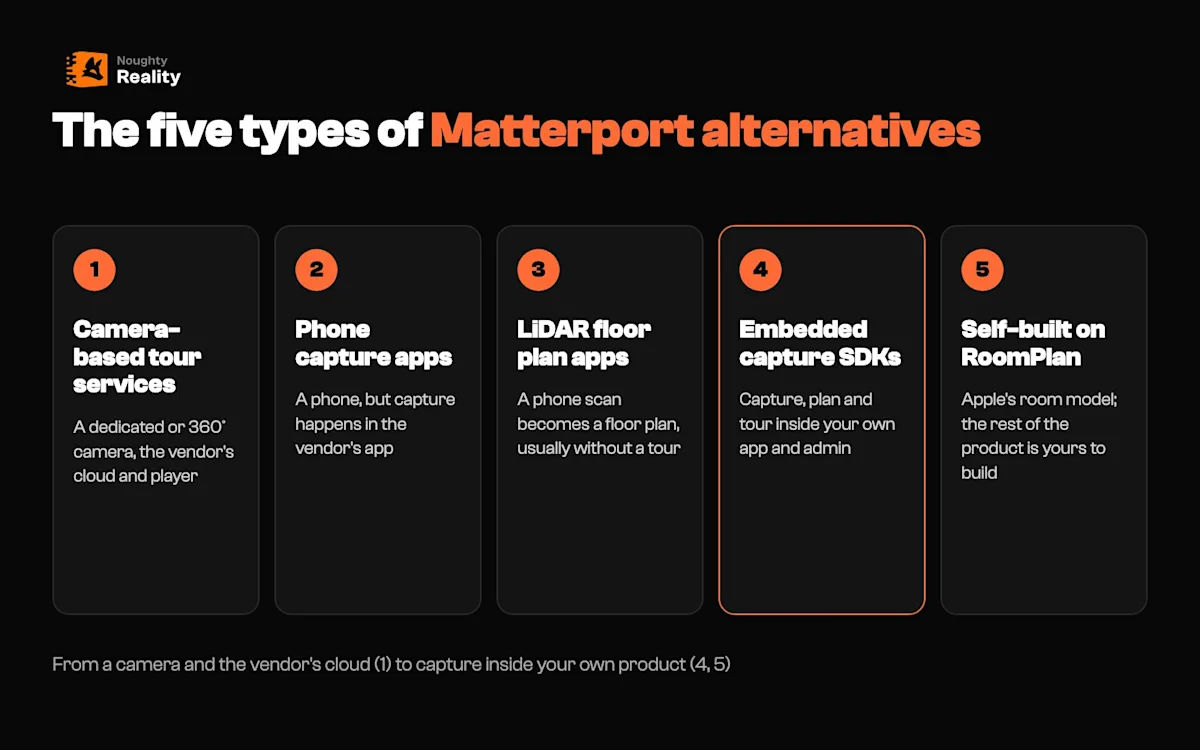
The five kinds of Matterport alternatives
Camera-based tour services
Someone shoots with a dedicated camera and the vendor's cloud builds and hosts the tour. Giraffe360 has a plan that includes its own camera, an auto-height tripod and a field kit, and it produces HDR photos, floor plans, virtual tours and 3D videos. Its pricing page shows subscription tiers with yearly project allowances and monthly AI credits. CloudPano accepts any 360° camera, video, or its own mobile app, and wants 360° photos in a 2:1 ratio. Its higher plans include white-label hosting on your own URL, and it lists a "Tour Creator SDK" for creating tours in your app. Kuula handles panoramas from cameras like Ricoh Theta, Labpano and Insta360, with custom branding on the PRO plan and your own domain on the Business plan.
These make sense for a team that photographs properties as a service and cares most about how each tour looks. For a platform the weak point is the extra device. Somebody has to carry and charge it, and the capture usually happens outside your product.
Phone capture apps
The user shoots with a phone, in the vendor's app. Matterport itself supports this with compatible iPhones and Android phones, and its device list says iPhones with LiDAR or ultra-wide cameras do best. For the occasional tour that is fine. On a busy field schedule, leaving your product for every visit, logging in elsewhere and then getting the result back into your system wears people down fast.
LiDAR floor plan apps
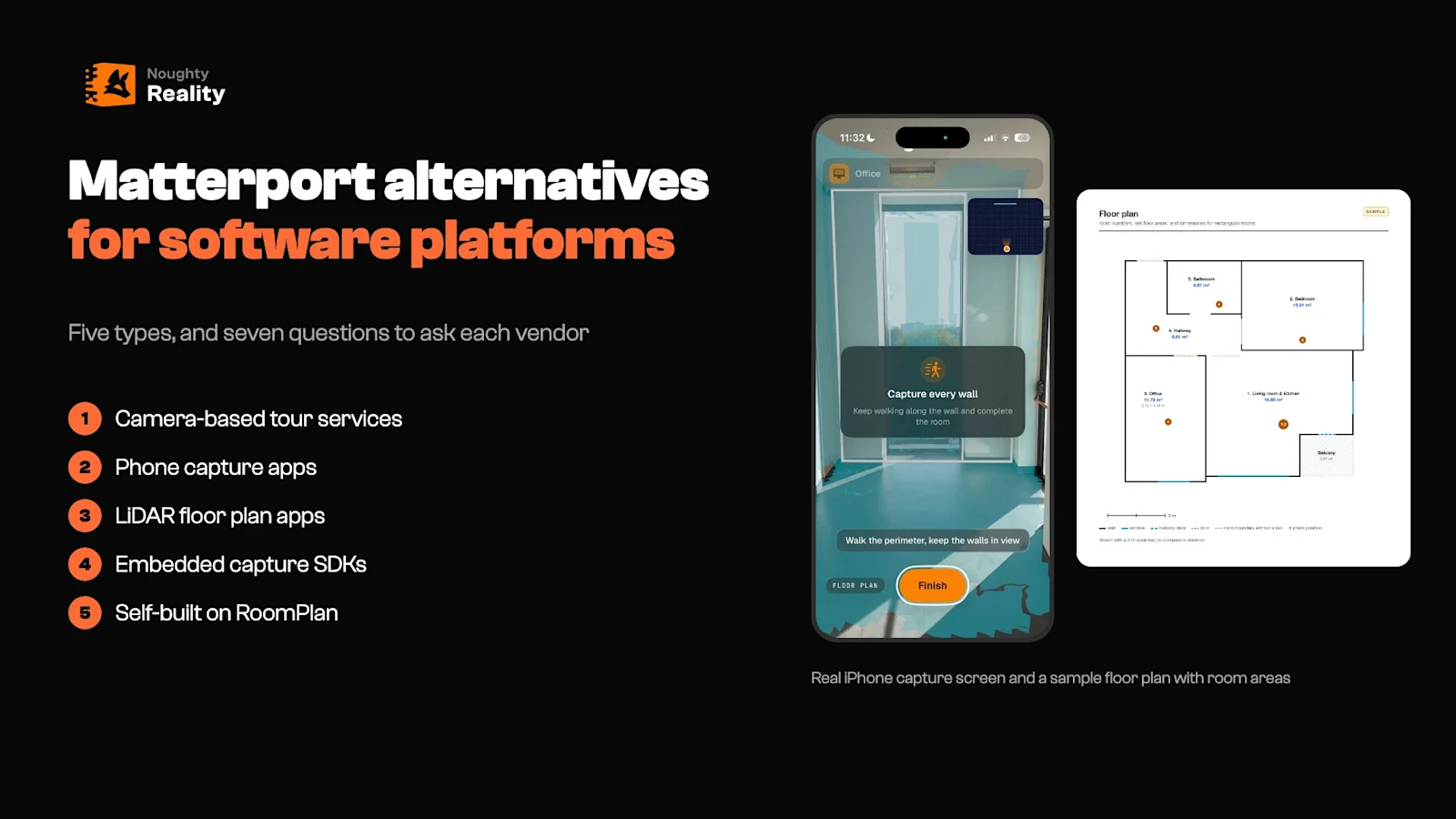
These use the iPhone's LiDAR sensor to scan rooms and return a floor plan. Some draw the plan on the phone, and others send the scan to a cloud service or a drafting team. If your users need a plan with room sizes and nobody has asked for a tour, this group deserves a look. I would ask how long the plan takes to come back, whether you receive editable plan data or a picture of a plan, and whether a tour can come from the same visit.
Embedded capture SDKs
Here capture, processing and viewing live inside your own app and admin panel. The user taps a button in your product, walks the property, and the result lands on your backend. We work in this category, so weigh my view accordingly. It suits a platform whose users visit every property anyway and which wants tours and plans under its own name. The honest cost is that you need a mobile app to put it in, and your engineers will spend real time on the integration.
Building on Apple RoomPlan
RoomPlan is Apple's Swift API. It uses the camera and LiDAR scanner on iPhone and iPad to build a 3D floor plan of a room, with dimensions and furniture types, exports USD or USDZ files, and ships with a coaching interface for the user. If you have iOS and 3D engineers and want full control, it is a serious option. Be realistic about the scope, though. RoomPlan gives you a room model. Panoramas, a tour, a 2D plan with room areas, storage, a web viewer, editing, and keeping all of it alive through every iOS release would still be yours to build and maintain.
What I would ask any Matterport alternative
The first thing I want to know is whether capture can run inside our app and what the user sees while it runs. When users capture in someone else's app, you lose the visit, and the visit is the moment your product matters most.
Next comes hardware. A dedicated camera costs money and tends to stay in the car. Everyone already carries a phone, but check the exact models, because LiDAR capture needs a Pro iPhone.
"White label" gets used for very different things. Sometimes it means swapping the logo in the vendor's player. Sometimes the tour genuinely lives on your domain. Ask where the tour opens and whose name is on the link your client receives.
On data, find out what you can export (panoramas, floor plan data, meshes, raw scans), in which formats, and whether the contract actually says so. Ask what happens to hosted tours if you stop paying. Then ask what exists for mobile, web and backend integration, and whether your backend gets a webhook when a capture is ready. An API that reads tours out of a vendor's system will not put capture into your app.
The last question is where processing happens. When panoramas and plans are built in the cloud, the user often sees the result after leaving the property. When the phone does the work, they can check each room on site and reshoot what is missing before they drive away.
Matterport pricing and paying per job
How a vendor charges will shape your costs more than the number on its price list. Matterport's hosted-space subscriptions charge for the number of spaces online at once, plus users, which works for a team that keeps a fairly stable set of tours live. Subscriptions with allowances, like Giraffe360's project allowances or CloudPano's plans, suit a steady monthly volume. Per-job pricing charges for each capture or each published tour, which fits a platform whose volume rises and falls with its customers' visits.
Before comparing quotes, I would write down how many tours you do in a month, how long each one has to stay online, and how many people capture. Then send that same volume to every vendor and ask what it costs. Remember the captures that never get published and the old tours that still have to stay online, because those are the lines that surprise people later.
The Matterport API and an embedded SDK solve different problems
A lot of teams search for the Matterport API hoping it will put capture into their own product. It was built for something else. Matterport's developer page says the Showcase SDK controls its 3D player, so you can add content and react to events, and the APIs manage model data, assets and accounts. All of that works on spaces captured in Matterport's system.
An embedded capture SDK starts one step earlier, at the capture itself, which runs in your app and sends the result to your backend. So the decision in front of you is whether you want to display Matterport tours inside your product or own the capture yourself.
When I would still recommend Matterport
I tell some teams to stay with Matterport, and I mean it. If your clients ask for Matterport by name, fighting that is rarely worth it. If you capture large or outdoor spaces, a dedicated LiDAR camera like the Pro3 was built for that work. If you need CAD, BIM or E57 files from the same capture, Matterport sells those outputs. And a company that wants one vendor covering everything from phones to professional cameras will find that in Matterport.
Where Noughty Reality fits
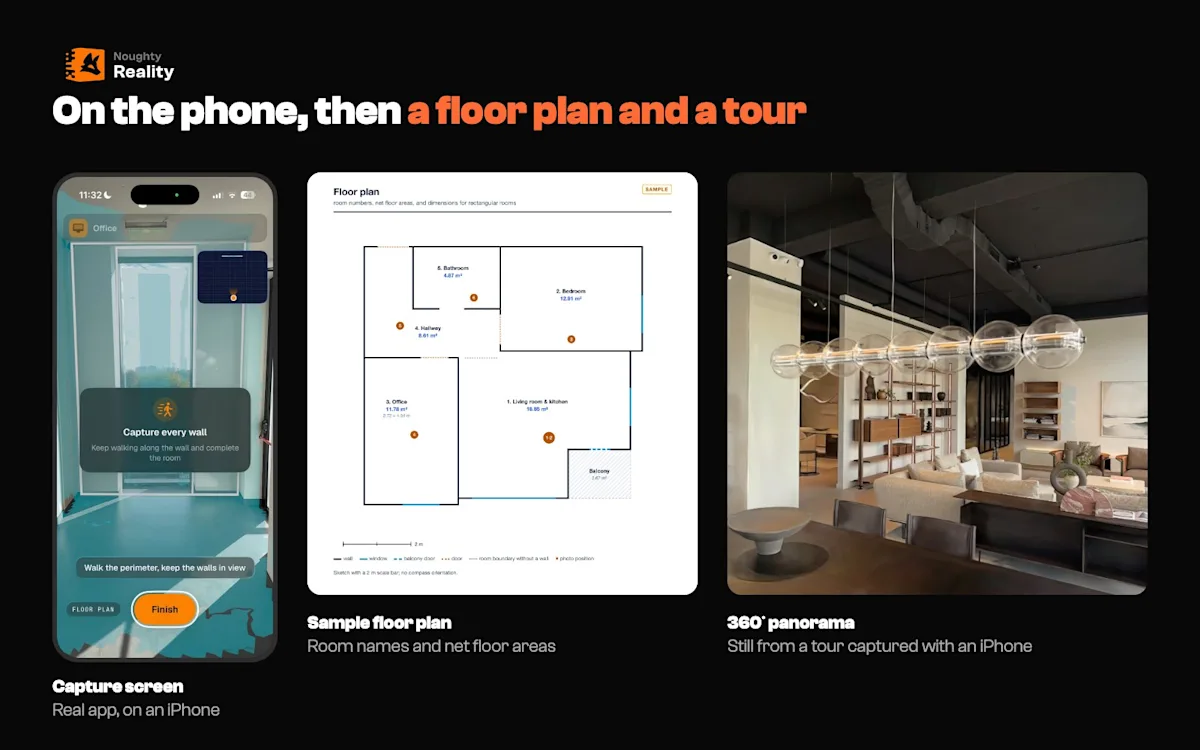
We build one of those embedded capture SDKs. Put it in your app, and one iPhone walk-through gives you a floor plan with room areas and a 360° tour, with each panorama pinned to its spot on the plan. See sample tours.